Phonics Explained: A Quick Guide
Contents
- Foundations of Sound: Phonemes and the Alphabetic Code
- The Building Blocks of Spelling: Graphemes
- Core Literacy Skills: Phonological vs. Phonemic Awareness
- Advanced Spelling Mechanics: Split Vowels, Schwas, and Consonants
- Effective Teaching Methods: Synthetic Phonics and Decoding/Encoding
- Word Analysis: Morphemes and Multidimensional Perspectives
- The Role of Decodable Books
- Cognitive Load in Reading Instruction
- The Importance of a Scope and Sequence
1. Foundations of Sound: Phonemes and the Alphabetic Code
A phoneme is the smallest unit of sound within a word. For example, the word "cat" consists of three distinct phonemes: /k/, /a/, and /t/.
The English Alphabetic Code is built upon 44 phonemes. These sounds are represented by approximately 175 different letter combinations. Teaching reading involves demonstrating how letters on a page spell the sounds in words.
2. The Building Blocks of Spelling: Graphemes
A grapheme is a specific spelling of a sound (phoneme) in a word. Graphemes can range from one to four letters in length:
- 1-letter grapheme: c-a-t (/k/ /a/ /t/)
- 2-letter grapheme: sh-o-p (/sh/ /o/ /p/)
- 3-letter grapheme: n-igh-t (/n/ /ie/ /t/)
- 4-letter grapheme: d-ough (/d/ /oe/)
3. Core Literacy Skills: Phonological vs. Phonemic Awareness
Phonological Awareness is an umbrella term for the ability to identify sound structures in words. This includes:
- Syllables: mag-net, lift-ed
- Alliteration: Ali alligator acts angrily
- Rhyme: fat, cat, mat
- Onset and Rime: h-at, m-at
Phonemic Awareness is a specific subset of skills within phonological awareness. It is the ability to identify and manipulate individual sounds (phonemes) in words, such as blending sounds for reading or segmenting them for spelling.
4. Advanced Spelling Mechanics
- Split Vowel Spellings: Also known as "silent e" or VCe (vowel-consonant-e). This occurs when a consonant splits the letters representing a vowel sound, such as the /ae/ in "gate" or /ie/ in "fine".
- The Schwa: A weak vowel sound in an unstressed syllable, such as the 'e' in "chicken". Children are taught to use a "spelling voice" to ensure they spell these muffled sounds correctly rather than just as they hear them.
- Consonants: Adjacent consonants (clusters) represent two separate sounds, like /s/ and /t/ in "stop". A consonant digraph is where two consonants combine to spell one single sound, like /sh/ in "ship".
5. Effective Teaching Methods
Based on established research, Synthetic Phonics is the most effective way to teach all children to read.
| Feature | Synthetic Phonics | Analytic Phonics |
|---|---|---|
| Approach | Sound out individual sounds and blend them. | Break the word into larger parts. |
| Process | "Synthesizes" sounds into a word. | "Analysis" of onset and rime. |
| Example | /f//r//o//g/ | 'fr' + 'og' |
Decoding (reading) and Encoding (spelling) are reversible processes and should be taught together in the same lesson.
6. Word Analysis: Different Perspectives
A single word can be viewed in multiple ways to aid understanding:
- Letters: Individual characters representing sounds.
- Syllables: "Mouthfuls" of words (re-mained).
- Phonemes: Individual speech sounds (/r//ee//m//ae//n//d/).
- Graphemes: The spellings of those sounds (r-e-m-ai-n-ed).
- Morphemes: Units of meaning (re-main-ed).
7. The Role of Decodable Books
Decodable books are essential tools because they:
- Provide a purpose for learning phonics.
- Offer practice with previously taught phonics.
- Develop good reading strategies by encouraging sounding out instead of guessing.
- Offer an experience of reading success and motivation.
- Develop student independence.
8. Cognitive Load in Reading Instruction
To avoid cognitive overload, teachers should limit lesson content to what is intrinsic to the specific skill being taught.
- Intrinsic to Decoding: Sound/letter correspondences, blending, segmenting, and understanding that sounds can be spelled in different ways.
- Extraneous to Decoding: Rhyme, alliteration, and letter names (while important for general literacy, these can be distracting when first learning to decode).
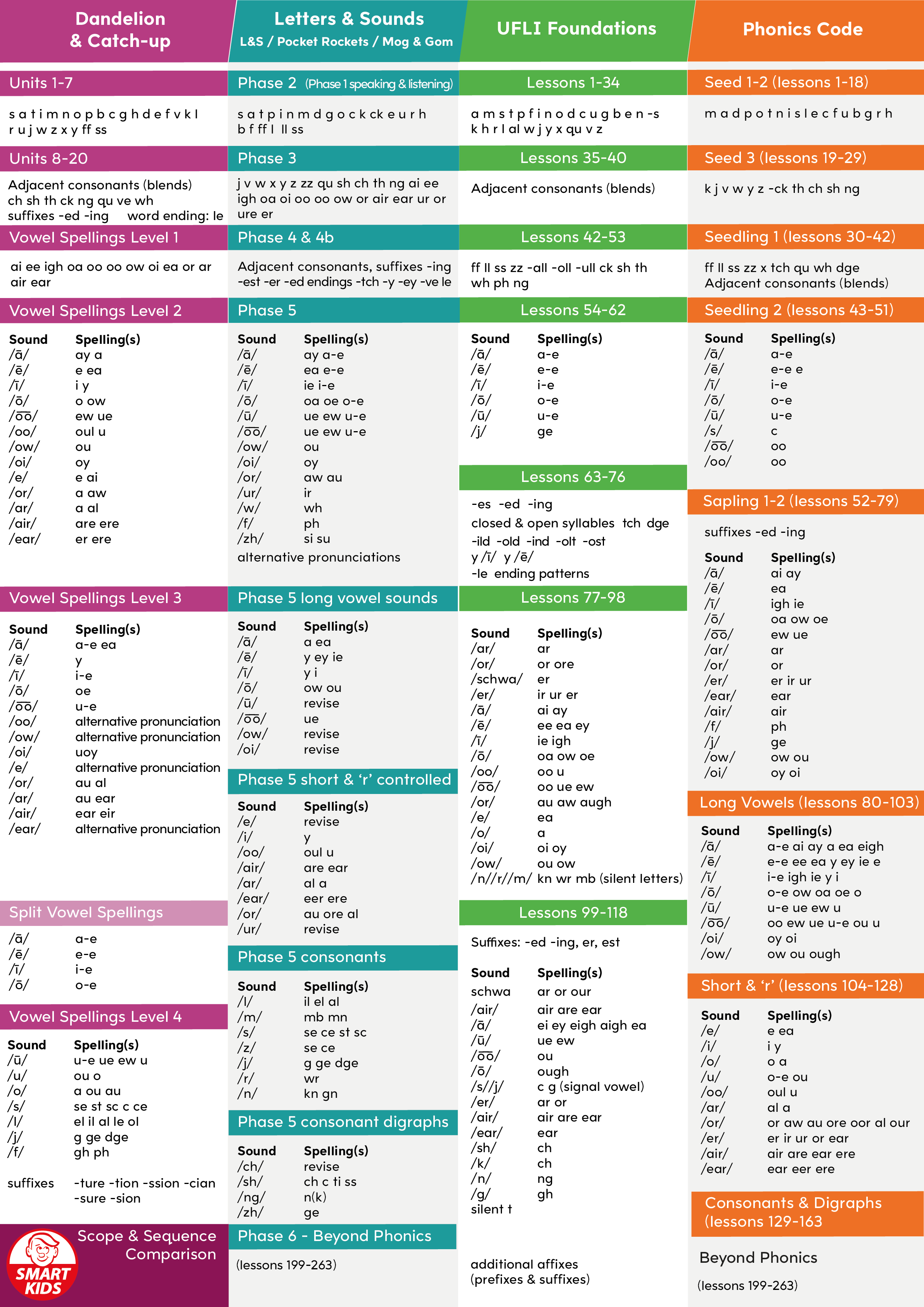
9. The Importance of a Scope and Sequence
A Scope and Sequence is the logical blueprint of a reading program. It defines what is being taught (scope) and the order in which it is introduced (sequence).
- Logical Progression: It ensures that students move from simple 1:1 sound/letter correspondences (like 's', 'a', 't') to more complex structures (like digraphs and split vowels) in manageable steps.
- Eliminating Gaps: A structured sequence ensures no part of the Alphabetic Code is missed, providing a solid foundation rather than a "shaky" one built on random exposure.
- Building Confidence: By introducing skills cumulatively, students can immediately apply what they've learned to read whole words, creating "instant success" and higher motivation.
- Efficiency: It maximizes learning time by focusing on the most common and reliable patterns first, allowing children to begin decoding meaningful text as quickly as possible.
Smart Kids offer decodable books and resources that match the Phonic Book Dandelion and Catch-up series (Sounds-Write), as well as Letters and Sounds, Phonic Code and UFLI.